The Best Emo Albums on Vinyl
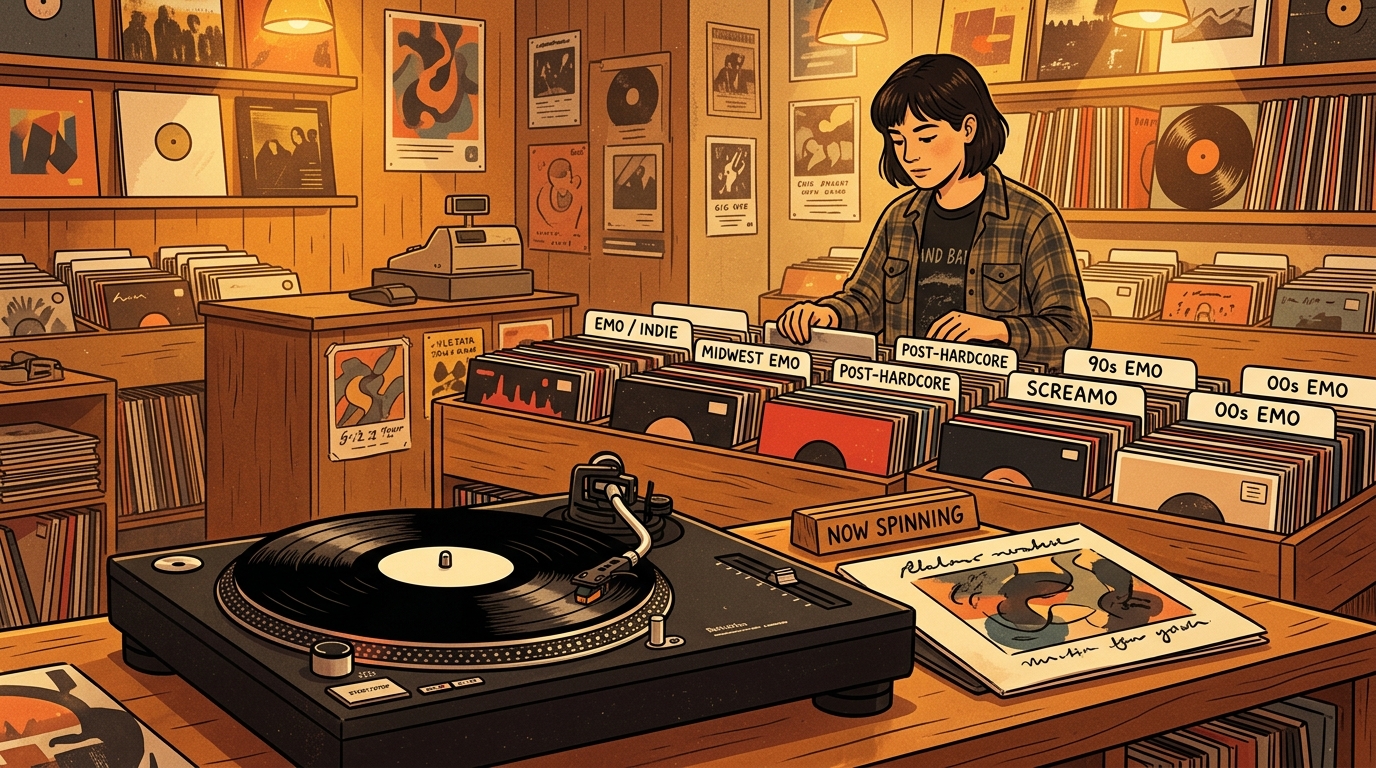
Emo makes unusually good sense on vinyl because the genre has always rewarded attention. The quiet parts matter, the room sound matters, and the sequence usually matters as much as the singles. A good emo record is rarely just a batch of cathartic choruses; it is a document of a scene, a budget, a label, a studio, and a particular moment when the band found out how much tension could fit inside a guitar tone.
This guide focuses on the best emo albums vinyl collectors should know first, from Washington, D.C. post-hardcore roots to Midwest mathy clean guitars, early-2000s Vagrant and Victory era staples, and later revival records that made younger collectors care about variants, represses, and side splits again. I leaned on release histories from MusicBrainz, cover data from the Cover Art Archive, and background references from each album's Wikipedia page where available. If you use What's Spinning to automatically log what your turntable plays, this is exactly the kind of list that makes listening history useful: you can see whether you actually return to the canonical records or just like owning them.
-
Rites of Spring, Rites of Spring, 1985. Before emo became a word people argued about on message boards, Rites of Spring put melody, rage, and vulnerability into the same Washington, D.C. room. The album was recorded at Inner Ear Studios in February 1985, produced by Ian MacKaye, and released as Dischord Records number 16, details that matter because the record still sounds tied to the physical conditions of that scene. It is fast and raw, but not careless; the guitars scrape, Guy Picciotto sings like the microphone is a witness, and the rhythm section keeps the whole thing from dissolving.
On vinyl, this one is less about audiophile polish than historical proximity. Early Dischord pressings are collectible, but the widely available reissues keep the music in print without turning it into museum glass. The cover's stark band-photo simplicity also tells the truth about the record: no mythology, no costume, just people in a room pushing hardcore toward confession. Start here if you want the family tree rather than the radio era. Source: Wikipedia.
-
Sunny Day Real Estate, Diary, 1994. The first thing Diary gives a vinyl listener is space. Released by Sub Pop in 1994, Sunny Day Real Estate's debut arrived from Seattle but sounded like it belonged to a different weather system than the grunge boom around it. Jeremy Enigk's voice jumps from private prayer to full-band alarm, while Dan Hoerner's guitar lines create a lattice that later Midwest emo bands studied closely.
The record's collector appeal is partly visual. The handwritten title and children's-book-like cover art feel fragile before the needle even hits. Musically, the side break helps the album breathe; it turns the first half's nervous lift into a second half that feels more shadowed and inward. Original vinyl copies can be expensive, and later Sub Pop reissues are usually the sane buy for people who plan to play the thing. Diary is one of the clearest examples of a second-wave emo album that became canonical without needing a neat pop single to explain it. Source: Wikipedia.
-
Weezer, Pinkerton, 1996. Pinkerton is the major-label outlier that keeps sneaking into emo record collections even when purists try to lock the door. Rivers Cuomo wrote much of it after abandoning the Songs from the Black Hole concept and while attending Harvard, and the result is a tense, messy rock album that rejected the clean blue-album sheen. The guitars are blunt, the drums feel boxed-in and urgent, and the writing is uncomfortable enough that its reputation has changed dramatically over time.
Collectors should care about the mastering history here. This is a mid-1990s CD-era album whose vinyl life has been shaped by later demand, audiophile editions, and reappraisal. It did not become a beloved vinyl staple because it was originally treated like a prestige LP; it became one because listeners kept returning to the record's abrasion. The Hiroshige-inspired cover art also makes the jacket feel unusually deliberate for a 1996 alt-rock release. If you want one album that explains how power-pop, shame, and emo-adjacent intensity crossed into the mainstream, Pinkerton earns the shelf space. Source: Wikipedia.
-
Braid, Frame & Canvas, 1998. Braid's Frame & Canvas does not enter quietly; it snaps into place with the confidence of a band that had already learned how to make odd angles feel communal. Released by Polyvinyl, it captures the late-1990s Midwest circuit at a point when basement-show energy and careful musicianship could still share the same van. Bob Nanna and Chris Broach trade voices like arguments between friends who know each other too well, and the rhythm section treats momentum as architecture.
The vinyl version is satisfying because the songs are compact but not cramped. A side of Frame & Canvas feels like a run of handwritten notes, fast, specific, and full of switchbacks. It is also a useful collector record because Polyvinyl has kept much of this era accessible through reissues, which means you can chase variants if you want, but you do not have to treat the album as an impossible relic. The cover's muted graphic design has aged better than plenty of louder late-1990s packaging. Source: Wikipedia.
-
The Get Up Kids, Something to Write Home About, 1999. Few records explain the Vagrant era as efficiently as this one. Released in 1999 by Vagrant and the band's Heroes & Villains imprint, Something to Write Home About turned Kansas City heartbreak into a touring engine. The keyboards are not decoration; they brighten the edges of songs that might otherwise collapse under their own restlessness. Matt Pryor's melodies made the record approachable, but the band still played with the clipped drive of a group raised on punk rooms rather than radio consultants.
For vinyl buyers, the album's charm is its balance between sentiment and motion. The track list moves quickly, and the side flip lands at the point where the record has already made its case but still has enough left to deepen it. Original pressings can command real money because the album sits at the center of late-1990s emo collecting, while anniversary editions make a cleaner entry point. Put it on when you want the version of emo that learned how to be communal without losing its diary-page urgency. Source: Wikipedia.
-
Jimmy Eat World, Clarity, 1999. Clarity is the rare album whose production ambition feels gentle rather than inflated. Jimmy Eat World made it for Capitol after Static Prevails, and the label relationship was uneasy, but the record itself sounds patient, layered, and uncynical. Bells, strings, electronics, and stacked vocals appear without turning the songs into studio furniture. The long closing track, "Goodbye Sky Harbor," is the obvious endurance test, yet the smaller moments are what make the album survive repeated spins.
On vinyl, Clarity benefits from being treated as an album-length arc rather than a prelude to Bleed American. The warm midrange helps the guitars and vocals sit together, and the sequencing gives side breaks a narrative function. Collectors should look closely at edition notes because this record has moved through different reissue cycles, and the best choice is usually the pressing with the cleanest surfaces, not necessarily the rarest color. Clarity belongs in this list because it made expansiveness feel emotionally precise. Source: Wikipedia.
-
American Football, American Football, 1999. A house on the cover can become a genre landmark if the music inside is patient enough. American Football's debut, often called LP1, was released by Polyvinyl in 1999 and built its reputation slowly after the band had already ended. Mike Kinsella's clean guitar figures, Steve Lamos's trumpet and drums, and the group's open tunings created a record that felt less like confession and more like remembering a room after everyone has left.
The vinyl appeal is obvious but not simple. This is a quiet, detail-heavy record, so surface noise matters more than it does on louder post-hardcore titles. The side break also changes the way the album lands; it gives the listener a pause that mirrors the music's empty-space obsession. Later reissues and deluxe treatments turned LP1 into a serious collector object, but the most important thing is getting a flat, quiet copy. It is one of the defining records for people who came to emo through clean tones, mathy intervals, and late-night restraint. Source: Wikipedia.
-
Thursday, Full Collapse, 2001. Full Collapse brought political anxiety, post-hardcore force, and emotional directness into a shape that a much larger audience could understand. Released by Victory Records in 2001, it introduced many listeners to the New Jersey band's mix of screamed release and melodic lift. Geoff Rickly's voice is not pretty in the conventional sense, which is precisely why the record works; it sounds like urgency refusing to be edited into politeness.
As a vinyl record, Full Collapse is a pressure record. The dense guitars and hard transients can punish a bad setup, but a good copy gives the album more body than the compressed digital versions many listeners grew up with. Its cover art, with that pale blue medical starkness, still feels connected to the album's themes of damage and recovery. Victory-era vinyl can be a minefield of variants and condition issues, so playback grading matters. Buy this for the way it captures emo's early-2000s collision with post-hardcore, not just for nostalgia. Source: Wikipedia.
-
Dashboard Confessional, The Places You Have Come to Fear the Most, 2001. Chris Carrabba made the bedroom feel like a venue. Released in 2001 through Vagrant, The Places You Have Come to Fear the Most stripped emo down to acoustic guitar, raw vocal proximity, and direct address. That choice was divisive, but it also changed the scale of the genre. Suddenly the quietest person in the room could become the loudest singer when everyone knew the words.
Vinyl turns the record's intimacy into a physical advantage. The acoustic attack, breath, and crowd-memory quality of the performances sit well in a format that rewards midrange texture. It is not the most complex album on this list, and that is part of the point. The jacket art and the stark presentation match a record built around exposure rather than arrangement. Collectors should treat condition seriously because sibilance and inner-groove wear are easy to hear on sparse acoustic songs. Keep this one for the nights when full-band catharsis would feel like overstatement. Source: Wikipedia.
-
Taking Back Sunday, Tell All Your Friends, 2002. Tell All Your Friends is practically engineered for call-and-response, but its best trick is how chaotic it feels without losing its hooks. Released by Victory Records in 2002, Taking Back Sunday's debut pushed Long Island scene drama into overlapping vocals, sharp bass movement, and choruses that seemed designed to be yelled from the back of a packed room. The album title itself comes from a line in "Cute Without the 'E' (Cut from the Team)," which tells you how quickly the songs became self-mythologizing.
On vinyl, the record works as a time capsule of early-2000s emo's social architecture. It is not only about heartbreak; it is about friend groups, arguments, borrowed cars, message boards, and shows where everyone seemed to know too much about everyone else. Pressing quality varies across reissues, so check listener notes before buying a fancy variant. The album's energy is forgiving, but noisy vinyl can blur the vocal interplay that makes it special. Source: Wikipedia.
-
Brand New, Deja Entendu, 2003. Deja Entendu widened Brand New's frame before the band fully disappeared into darker art-rock territory. Released in 2003, it kept some of the scene's sharp-tongued immediacy while adding stranger structures, slower builds, and a sense of distance from the pop-punk circuit that had first received them. The astronaut cover is one of the era's most recognizable jackets, and it still looks good in a crate because it suggests both escape and isolation.
The vinyl conversation around Deja Entendu is inseparable from demand. For years, the album's availability, reissues, and secondary-market prices helped turn it into a collector rite of passage. The music justifies the attention when you hear how carefully the band spaces its peaks. "The Quiet Things That No One Ever Knows" is the obvious single, but the deeper cuts give the LP its shape. Given the band's complicated public history, some collectors approach Brand New records differently now. From a format standpoint, though, Deja Entendu remains a key example of emo growing more cinematic without abandoning hooks. Source: Wikipedia.
-
Death Cab for Cutie, Transatlanticism, 2003. Not every essential emo-adjacent vinyl record needs to sound like a basement show. Transatlanticism, released by Barsuk in 2003, uses indie rock patience to reach an emotional temperature many louder bands only gesture toward. Ben Gibbard's writing is precise, sometimes plainspoken, and Chris Walla's production gives the album a cool distance that makes its big moments feel earned.
The title track is the collector's test because its repetition and slow expansion reward a quiet room. On a decent pressing, the piano, drums, and vocal layers gather force gradually rather than arriving as a single block. The album also matters because it pulled a particular kind of emotionally literate guitar music toward a broader audience without flattening it into pure adult alternative. If your emo shelf includes only frantic records, Transatlanticism adds negative space, long-distance melancholy, and one of the cleanest side-two emotional payoffs of the 2000s. Source: Wikipedia.
-
My Chemical Romance, Three Cheers for Sweet Revenge, 2004. Three Cheers for Sweet Revenge made melodrama feel dangerous again. Released by Reprise in 2004, My Chemical Romance's second album sharpened the rougher theatrical instincts of I Brought You My Bullets into a tighter, blood-red revenge story. Gerard Way's comic-book sense of image and motion is all over the record, but the band plays with enough punk momentum to keep the concept from floating away.
Vinyl buyers come to this one for color as much as sound, and the red-black cover practically invites variant culture. Still, the record is more than a wall display. The pacing is ruthless, the singles are placed with confidence, and the album's compact runtime helps it avoid the bloat that can sink concept-heavy rock records. It also marks the point where emo, goth presentation, pop-punk, and post-hardcore began merging into a mainstream visual language. A clean pressing gives the guitars some needed separation, especially on a system that can keep the choruses from hardening into glare. Source: Wikipedia.
-
Brand New, The Devil and God Are Raging Inside Me, 2006. This album begins like a secret and ends like a building losing power. Released in 2006, The Devil and God Are Raging Inside Me pushed Brand New into heavier, stranger, more patient territory. The leaked demos that preceded it became part of the record's lore, but the finished album matters because it sounds obsessively arranged without feeling clean. Silence, feedback, and sudden volume shifts do as much narrative work as the lyrics.
For vinyl, dynamics are the reason to care. The album's quiet passages need a low-noise copy, while the explosive sections need mastering that does not flatten the contrast. The cover, with Nicholas Prior's eerie photograph of masked children in a doorway, remains one of the most unsettling pieces of packaging in the genre. Again, the band's later reputation complicates how people collect these records, and that context is real. Judged as an object and recording, it is a central 2000s emo LP because it proved the scene could age into dread instead of simply polishing its hooks. Source: Wikipedia.
-
My Chemical Romance, The Black Parade, 2006. The Black Parade is what happens when a band treats the album format like theater and then actually has the songs to survive the gesture. Released in 2006, it follows a dying character known as The Patient and folds Queen-sized drama, punk velocity, cabaret touches, and arena-rock confidence into one of the decade's defining rock statements. It reached number two on the Billboard 200, a useful reminder that emo's mid-2000s commercial peak was not a niche event.
As vinyl, The Black Parade is a big-jacket record in every sense. The artwork, the concept, and the side breaks all encourage a front-to-back listen rather than cherry-picking "Welcome to the Black Parade." Because the production is dense, pressing and setup matter; inner-groove congestion can make the busiest moments feel crowded. The best copies preserve the record's theatrical depth without sanding off its punk edges. If you only own one mainstream emo blockbuster, this is the one with the strongest claim as a complete LP. Source: Wikipedia.
-
The Antlers, Hospice, 2009. Hospice is often filed beside indie rock, but its emotional logic belongs in the emo vinyl conversation. Peter Silberman first self-released the album before Frenchkiss gave it wider release, and the record's story of illness, care, control, and collapse is almost unbearably focused. Rather than chase chorus catharsis, it builds dread through falsetto, distortion, and fragile arrangements that seem to bruise when they get loud.
A vinyl copy of Hospice asks for patience from the listener and honesty from the system. Surface noise can either add atmosphere or wreck the intimacy, depending on the pressing and condition. The album art's blurred, clinical abstraction suits music that treats memory as something unstable. It is not a party record, obviously, but it is one of the strongest late-2000s examples of the album as emotional enclosure. Collect it if you want the quieter, more devastating branch of emo-adjacent storytelling represented on your shelves. Source: Wikipedia.
-
The Hotelier, Home, Like Noplace Is There, 2014. The emo revival did not need a single manifesto, but Home, Like Noplace Is There came close. Released in 2014, The Hotelier's second album brought literary grief, communal shouting, and scrappy guitar-band force into a record that felt immediate without sounding retro. Christian Holden's writing is dense with loss and care, yet the band keeps pulling the songs back toward bodies in rooms, people singing together, and the messy work of staying alive.
Vinyl helped this album become a modern collector staple because its audience arrived during a period when younger listeners were already buying physical editions, variants, and limited runs online. The cover's plain house image echoes American Football's domestic iconography, but the music inside is far more volcanic. A good pressing makes the gang vocals and distorted peaks feel communal rather than smeared. If your collection jumps from 2006 straight to nostalgia comps, this is the record that explains why a new generation treated emo as a living form instead of a costume box. Source: Wikipedia.
What to buy first
If you are starting a vinyl shelf from scratch, buy in three waves. First, get the foundation records that define the language: Rites of Spring, Diary, Clarity, and American Football. Second, add the records that explain the commercial and scene explosion of the 2000s: Something to Write Home About, Tell All Your Friends, Full Collapse, Three Cheers for Sweet Revenge, and The Black Parade. Third, add the emotionally stranger or more expansive titles: Transatlanticism, Hospice, The Devil and God Are Raging Inside Me, and Home, Like Noplace Is There.
For value, do not assume the rarest pressing is the best listening copy. Emo vinyl can be noisy because many records were pressed for fans, not audiophile buyers, and plenty of used copies lived hard lives. Check matrix notes, read pressing comments, and favor a quiet black-vinyl reissue over a glamorous variant if playback is the goal.
FAQ
What makes an emo album good on vinyl?
Sequencing, dynamics, and midrange texture matter most. Emo records often rely on vocal strain, clean guitar detail, room sound, and sudden loud sections, all of which can feel more involving on a quiet, well-mastered LP. The format also encourages full-album listening, which suits records built around emotional arcs instead of isolated singles.
Are original emo pressings worth the money?
Sometimes, but not automatically. Original pressings of albums like Diary, Something to Write Home About, and American Football can be collectible because they represent a specific scene moment. For everyday listening, a clean modern reissue often beats an expensive first press with groove wear, warps, or noisy colored vinyl.
Which emo album should a new collector buy first?
Clarity by Jimmy Eat World is the safest first buy because it is melodic, album-minded, and detailed enough to reward repeat listens. If you want history, start with Rites of Spring or Diary. If you want the 2000s mainstream moment, start with The Black Parade.
Where should collectors find cover and pressing information?
Use MusicBrainz for release-group data, the Cover Art Archive for artwork, Discogs for marketplace and pressing notes, and label pages when they are available. Cross-check before paying a premium because emo albums often have many variants that look similar in photos.
A spreadsheet tracks what you own. What's Spinning identifies what's playing.
On-device vinyl ID logs your listening history automatically. 7-day free trial.
Looking for Shazam for vinyl?
What's Spinning identifies what's playing on your turntable on-device, logs history, and AirPlays now-playing to your TV.
Comparing vinyl ID apps?
Analog requires Discogs and is iPhone-first (iPad coming). What's Spinning works without Discogs on iPhone and iPad with AirPlay.
Try What's Spinning Free
Turn your iPad into a live now-playing display. Track every record you spin.
START FREE TRIALThen $4.99/mo or $39.99/yr · Cancel anytime