The Best Funk Albums on Vinyl: 18 Essential Records for Collectors
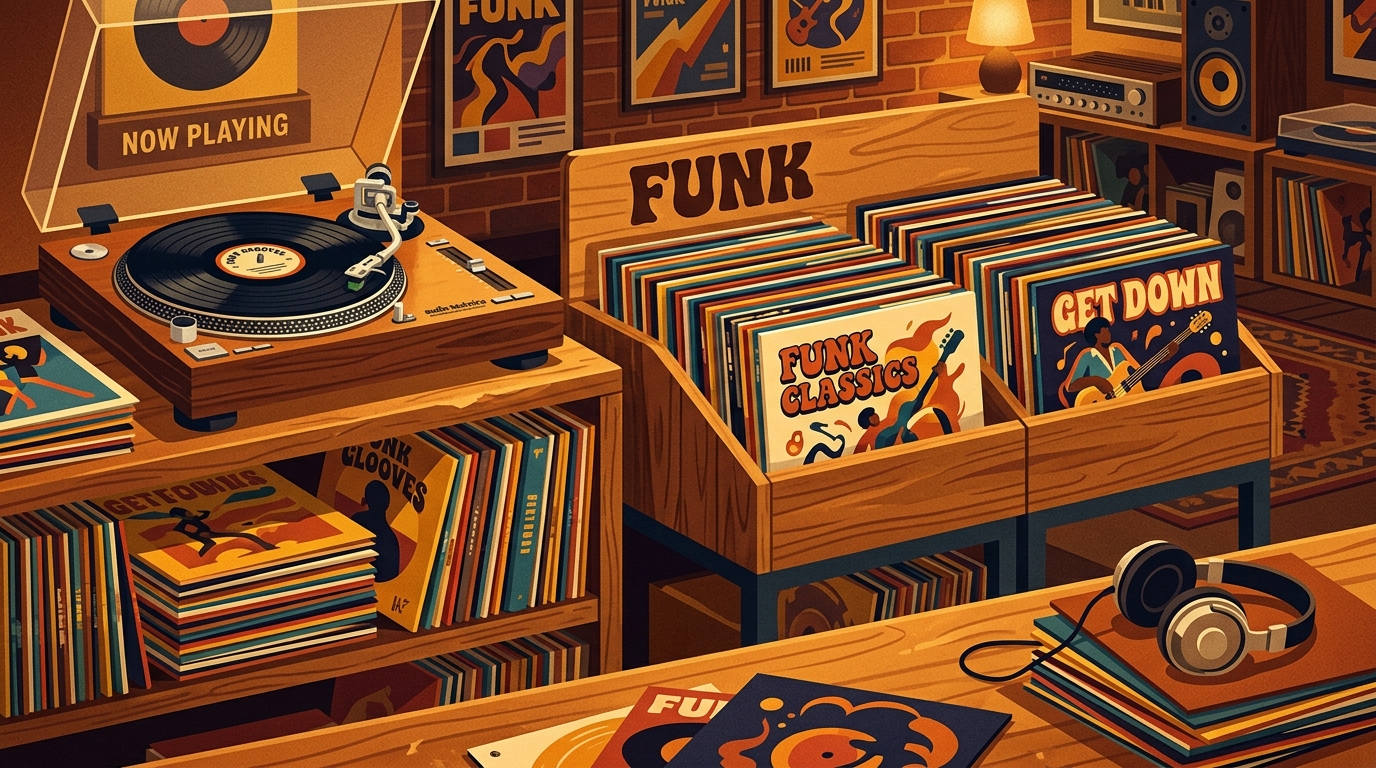
Funk is one of the best genres to collect on vinyl because the format flatters what the music values most: bass movement, drum feel, guitar texture, horn punctuation, sleeve art, and long grooves that need room to breathe. The best funk albums on vinyl are not only the most famous party records. They are albums where the band identity, production choices, side breaks, and physical packaging all add something you miss when the music becomes a loose playlist.
There is also a practical reason to care now. Vinyl is not a nostalgia footnote anymore. The RIAA's 2023 year-end report counted 43.2 million LP and EP shipments in the United States, worth about $1.35 billion. Billboard's coverage of Luminate's 2024 year-end music report said U.S. vinyl album sales rose again, up 4.3 percent. That bigger market has helped keep classic funk reissues in circulation, but it has also made clean originals and complete packages more competitive.
For What's Spinning users, funk is especially fun to track because these records often reveal your real habits. You might admire a rare pressing, but the app will show which LPs actually get played. This list favors records that matter as albums, not just records with one famous break, one sample, or one radio hit.
Research sources for this guide include album and artist pages from Wikipedia, release data from MusicBrainz, cover art from Wikipedia and the Cover Art Archive, the Library of Congress National Recording Registry, RIAA market data, and contemporary chart and certification references where available.
The best funk albums on vinyl
-

The Payback, James Brown, 1973
James Brown had already changed popular rhythm several times before The Payback, but this double LP is where his early-70s band sounds most dangerous on a home system. The album began as music for a proposed blaxploitation film, then became something bigger once the title track stretched into a revenge fantasy with bass, drums, guitar stabs, and Brown's clipped commands working like machinery. Collectors should notice the format: four sides give the grooves room, and the long vamps are not filler when the band is this precise. Original Polydor copies are common enough to hunt, but condition matters because the quiet tension in tracks like "Doing the Best I Can" exposes groove wear fast. As a vinyl experience, it is not polite funk. It is a band holding a pocket until every tiny accent becomes part of the plot.
-
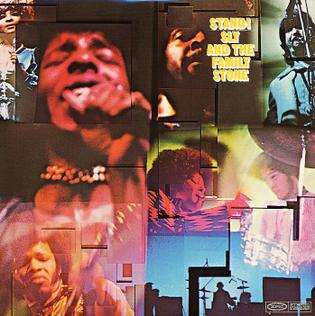
Stand!, Sly and the Family Stone, 1969
A party record can still carry political voltage, and Stand! proves it before the first side is over. Sly Stone's integrated, mixed-gender band made optimism sound muscular, not naive, with "Everyday People" and "I Want to Take You Higher" turning communal ideals into hooks strong enough for AM radio. The record's vinyl appeal comes from contrast. It bounces from tight singles to the extended closer "Sex Machine," a 13-minute jam that reminds you this was a working band, not just a studio concept. The album arrived in 1969, when soul, rock, psychedelia, and civil-rights-era pop were all colliding; that context is still audible in the bright horns and restless rhythm section. Clean Epic pressings have visual charm, but any good copy should make the room feel larger. Few funk records are this welcoming while still sounding like a revolution warming up.
-

There's a Riot Goin' On, Sly and the Family Stone, 1971
The surface of this album is cloudy on purpose. Where Stand! reaches outward, There's a Riot Goin' On turns inward, lowering the lights and letting drum machines, overdubs, tape murk, and emotional exhaustion become part of the arrangement. Its famous American flag cover, with suns replacing stars, looks simple until you hear how weary the music sounds underneath it. The record is often discussed as a response to the broken promises of the late 1960s, but collectors should also hear it as a production landmark. The grooves can feel thick and humid; a bright cartridge will not suddenly make it sparkle, and that is fine. This is funk after the party has curdled, with bass lines moving through fog and voices drifting like people entering and leaving a room. Buy it for the mood as much as the songs.
-

Maggot Brain, Funkadelic, 1971
The title track starts with Eddie Hazel playing as if blues, grief, acid rock, and gospel had been melted into one guitar line. That ten-minute opener can fool newcomers into thinking Maggot Brain is primarily a guitar-hero record, but the rest of the LP is just as important to the Funkadelic story. It catches George Clinton's crew before Parliament's spaceship mythology became dominant, still close to psychedelic rock and Detroit grit. The cover art, a woman's head emerging from the earth, remains one of funk's most unsettling jackets, which makes clean copies satisfying objects even before playback. On vinyl, the sequencing is a shock strategy: side one moves from elegy to dirtier ensemble grooves, while side two gets stranger and more confrontational. Expect surface noise to be especially annoying on the title track's exposed passages. This is the rare funk LP that asks for both volume and silence.
-

Mothership Connection, Parliament, 1975
Parliament did not merely make a funk album here; it built a whole operating system. Mothership Connection introduced Star Child, the Mothership, and a cosmic mythology that turned Black popular music into science fiction without losing the dance floor. Bootsy Collins, Bernie Worrell, Fred Wesley, Maceo Parker, and the wider P-Funk organization make the record feel crowded in the best possible way. Worrell's synthesizers are not decorative, they thicken the universe, while the horn charts snap the songs back to earth. Vinyl makes the theatrical scale easier to appreciate because the cover, the credits, and the side breaks all participate in the concept. "Give Up the Funk" is the anthem, but "P-Funk" and "Mothership Connection" are where the world-building really settles in. If you are buying one Parliament record first, this is usually the safest landing pad.
-

Funkentelechy vs. the Placebo Syndrome, Parliament, 1977
By 1977, P-Funk had become both band and cartoon empire, and Funkentelechy vs. the Placebo Syndrome is the moment when the packaging can feel almost as collectible as the music. Original copies may include the famous Sir Nose poster and comic-style artwork, so crate diggers should check the sleeve before judging the price. Musically, the album sharpens Parliament's mythology into a fight against the dulling forces of the Placebo Syndrome, which is a very Clinton way to say that boring rhythm is a civic emergency. "Flash Light" is the monster, powered by Bernie Worrell's synth bass line rather than a conventional bass guitar part, a production detail that still sounds futuristic. The LP rewards a system with good low-end control because the groove is elastic and busy. It is sillier than Mothership Connection, but it also argues harder for funk as liberation technology.
-

One Nation Under a Groove, Funkadelic, 1978
Funkadelic's most commercially successful album also has one of the most useful titles in the whole P-Funk catalog. One Nation Under a Groove turns the band's countercultural sprawl into a slogan, then backs it with songs flexible enough for clubs, headphones, and festival stages. The title track is the obvious entry point, but "Who Says a Funk Band Can't Play Rock?!" explains the group's refusal to stay in one bin. For vinyl buyers, editions matter because some original packages included a bonus EP, and later reissues vary in how they handle the extra material. The record's appeal is partly philosophical: funk is presented as a coalition, not a niche. The guitars still bite, the vocals still stack into chants, and the rhythms invite bodies before theory has time to catch up. It belongs near Parliament on the shelf, but it has a rougher, rockier grin.
-
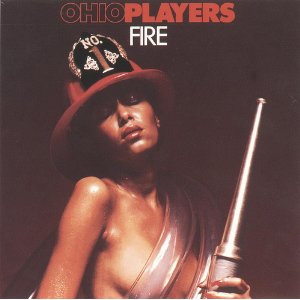
Fire, Ohio Players, 1974
The Ohio Players understood the album cover as theater. Fire arrived with the band's signature Westbound-to-Mercury-era visual provocation intact, and the music is just as direct: lean riffs, sticky clavinet, horns that know when to punch, and vocals that keep the heat on without over-explaining anything. The title track went to number one on the Billboard Hot 100, which says plenty about how far hard funk could travel in the mid-70s when the hook was undeniable. On vinyl, the album is a physical pleasure because it feels built from short, concentrated blasts rather than endless jam architecture. That makes it a strong store-bin buy, especially if you want funk that moves quickly from idea to payoff. Jackets can be worn or ring-marked because these records were played, handled, loaned, and brought to parties. A clean-playing copy is worth more than a pretty sleeve with tired grooves.
-

Wild and Peaceful, Kool and the Gang, 1973
Before the pop smoothness of the late-70s and early-80s hits, Kool and the Gang were a deeply disciplined funk unit with jazz in the bloodstream. Wild and Peaceful is where that identity breaks wide open for mainstream listeners, thanks to "Funky Stuff," "Jungle Boogie," and "Hollywood Swinging." The playing is crisp rather than chaotic, with horn lines and percussion arranged so the grooves feel communal instead of cluttered. It is a useful record for collectors because it connects several audiences: funk fans, breakbeat hunters, disco-era dancers, and people who only know the band from later radio staples. On vinyl, the best moments jump from the speakers with surprisingly little need for audiophile fussing. Look for copies that have not been chewed up by party use; the music is resilient, but inner-groove distortion can make the brass sound harsh. This is a reminder that precision can be just as funky as looseness.
-
That's the Way of the World, Earth, Wind and Fire, 1975
Earth, Wind and Fire made funk sound luminous. That's the Way of the World began as a soundtrack to a film, but the album outgrew the movie so completely that most listeners now meet it as one of the group's central statements. "Shining Star" gives the record its radio muscle, while the title track stretches into the kind of spiritual soul that Maurice White could make feel grand without becoming stiff. Vinyl helps because the arrangements are layered with kalimba, horns, vocal stacks, bass, and smooth rhythmic motion; a compressed stream can flatten that architecture. The collector angle is not rarity so much as condition and mastering. You want the top end clean enough for the harmonies and horns, and the low end firm enough for Verdine White's bass lines to stay elegant rather than bloated. This is feel-good music with serious craft underneath.
-

Rejuvenation, The Meters, 1974
New Orleans funk breathes differently, and Rejuvenation is one of the clearest ways to hear why. The Meters do not need to crowd the track; Zigaboo Modeliste's drumming shifts around the beat with conversational ease, George Porter's bass answers him, and Leo Nocentelli's guitar parts cut through like small jokes that happen to be perfectly timed. The album includes "Just Kissed My Baby," a groove so sly that it can sound simple until you try to count all the little decisions happening inside it. For vinyl collectors, this is not about bombast. It is about pocket, touch, and negative space. Original Reprise copies are desirable, but modern reissues have made the album easier to own without entering collector combat. Play it after a bigger P-Funk record and the contrast is useful: both are funk, but The Meters prove that restraint can make a groove feel deeper, not smaller.
-
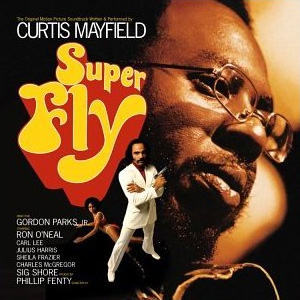
Super Fly, Curtis Mayfield, 1972
Curtis Mayfield wrote a soundtrack that argued with its own film. Super Fly is tied to blaxploitation cinema, but the album's moral intelligence is sharper than the genre label suggests, especially on "Freddie's Dead" and "Pusherman." Mayfield's falsetto floats above arrangements that mix strings, congas, wah-wah guitar, and bass lines with a delicacy many funk records never attempt. The result is a record that can groove hard while sounding haunted. Vinyl is the right format because the album plays like a suite, not a pile of theme songs, and the jacket immediately places it in its 1972 visual world. Collectors should know that old Curtom copies often show wear, but the music benefits from a copy quiet enough to preserve the orchestral details. If your funk shelf leans too heavily toward party records, Super Fly adds conscience, atmosphere, and cinematic pacing.
-

Head Hunters, Herbie Hancock, 1973
Jazz-funk does not get much more consequential than Head Hunters. Herbie Hancock had already helped stretch post-bop and electric jazz with Miles Davis, but this album made groove the organizing principle without giving up harmonic intelligence. "Chameleon" rides a synthesizer bass line that became a rite of passage, while "Watermelon Man" reworks Hancock's own tune through a new rhythmic frame inspired by African and Caribbean ideas. The Library of Congress selected Head Hunters for the National Recording Registry, noting its influence and its huge commercial impact for a jazz album. On vinyl, the sound design is half the fun: ARP synths, Fender Rhodes textures, percussion, and bass all occupy distinctive spaces. It is also an excellent system test because the record should feel both cerebral and bodily. If it only sounds like background fusion, either the pressing is dull or the volume is too timid.
-
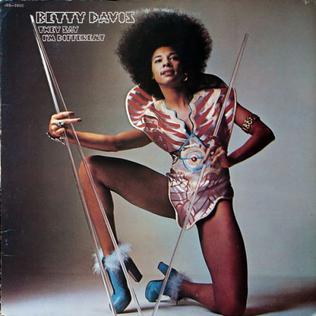
They Say I'm Different, Betty Davis, 1974
Betty Davis did not ask funk to behave. They Say I'm Different is raw, sexual, funny, confrontational, and often miles ahead of what the mainstream music business knew how to sell in 1974. Davis wrote with a blues historian's memory and a punk's patience for politeness, name-checking figures like Bessie Smith, Robert Johnson, and Big Mama Thornton in the title track while surrounding herself with hard, rubbery funk. Original Just Sunshine copies are prized partly because her catalog was neglected for years, making later reissues important access points rather than consolation prizes. On vinyl, the record's rough edges are the point. The guitars scratch, the bass prowls, and Davis sings as if she is daring the room to misunderstand her. It is not background funk, and it is not a safe dinner-party flex. It is a document of an artist whose influence took decades to catch up with her nerve.
-
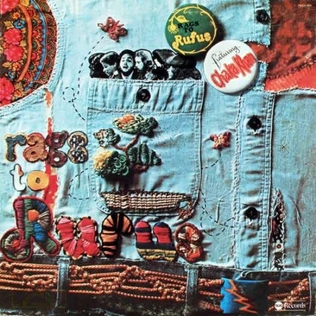
Rags to Rufus, Rufus featuring Chaka Khan, 1974
Chaka Khan's voice is the headline, but Rags to Rufus works because the band gives her a spring-loaded platform. "Tell Me Something Good," written by Stevie Wonder, became the breakthrough, winning a Grammy and introducing a sly, talkbox-colored groove that still feels mischievous. The album around it is more varied than one hit might suggest, moving through funk, soul, and rock touches with a 1974 studio-band confidence that rewards full-side listening. For collectors, this is a smart buy because it catches Khan before solo superstardom turned her into shorthand for vocal power. The jacket also carries period charm without the premium attached to more mythologized funk artifacts. On a good pressing, the rhythm section should feel nimble and Khan should sound huge without turning sharp. The album belongs here because it shows funk as a launchpad for personality, not just as a rhythm-section exercise.
-

Cymande, Cymande, 1972
Cymande were British, Caribbean-rooted, and rhythmically impossible to reduce to one scene. Their debut moves through funk, soul, reggae, jazz, Afro-Caribbean pulse, and meditative group vocals with a calm confidence that later made it a favorite source for hip-hop producers and rare-groove collectors. "Bra" and "The Message" are the obvious landmarks, but the whole LP has a patient sway that separates it from American funk's heavier stomp. The cover, with the dove-like bird symbol, has become part of the record's mystique. Vinyl buyers should be careful: originals can be expensive, and there have been multiple reissues, so know whether you are paying for sound, scarcity, or simply the thrill of the object. This is a record for the part of your collection that values feel over force. It does not kick the door down; it changes the room's temperature until everyone notices.
-

The World Is a Ghetto, War, 1972
War's funk is urban, Latin-inflected, spacious, and socially observant, and The World Is a Ghetto captures that blend better than any greatest-hits shortcut. The title track stretches past ten minutes, giving the band room to make melancholy feel communal, while "The Cisco Kid" brings the humor and bounce that helped the album reach a wide audience. This was one of 1973's biggest-selling albums in the United States, which means copies exist, but not all of them were treated kindly. The United Artists jacket has the kind of street-scene artwork that looks excellent in a vinyl rack, and the record itself benefits from relaxed listening. War rarely sounds rushed; the percussion, harmonica, organ, bass, and vocals settle into long arcs. If Parliament is outer space and The Meters are the second line, War is the boulevard at dusk, political, funny, weary, and warm.
-

1999, Prince, 1982
By the time 1999 arrived, funk had absorbed new machines, new club expectations, and a colder electronic vocabulary. Prince turned those changes into a double album that still feels handmade because his fingerprints are everywhere: drum programming, synth hooks, guitar, bass, vocals, arrangement, attitude. The title track and "Little Red Corvette" carried the record into pop history, but the funk collector should spend time with "D.M.S.R.," "Lady Cab Driver," and the long-form Minneapolis grooves where repetition becomes seduction. Vinyl matters because the original sprawl is part of the argument. It is not a tidy singles package; it is an after-hours world with neon edges and private jokes. Earlier pressings can be pricey in top condition, and reissues make more sense for many listeners. Either way, 1999 is the bridge from 70s funk mythology to 80s bedroom-studio futurism.
What to buy first
If you are building a funk shelf from scratch, buy across styles instead of grabbing five records that do the same job. Start with Mothership Connection for full-scale P-Funk theater, The Payback for James Brown's ruthless band discipline, and Rejuvenation for New Orleans pocket. Add Super Fly when you want songwriting and cinematic atmosphere, then choose either Head Hunters or 1999 depending on whether jazz-funk or electronic Minneapolis funk speaks louder to you.
Condition is the collector's trap. Funk records were often played at parties, on stackable changers, and through systems that were not gentle to inner grooves. Inspect the vinyl under strong light, check for spindle marks, and be skeptical of jackets that look better than the disc. For P-Funk titles, confirm whether posters, booklets, bonus EPs, or custom inners are included before paying a premium. For heavily sampled records, reissues can be the smarter route if your priority is listening rather than owning the earliest artifact.
FAQ
What funk album should I buy first on vinyl?
Start with Parliament's Mothership Connection if you want the full P-Funk universe, James Brown's The Payback if you want groove discipline, or The Meters' Rejuvenation if you want deep New Orleans pocket.
Are original funk pressings better than reissues?
Sometimes, but not automatically. Many original funk LPs were party records and can have groove wear even when the jacket looks acceptable. A clean, well-mastered reissue often beats a noisy original.
Why does funk sound so good on vinyl?
Funk depends on bass movement, drum feel, guitar scratches, horn stabs, and small timing choices. Vinyl listening encourages full-side attention, which helps long grooves and album sequencing make sense.
Which funk records are hardest to find cheaply?
Betty Davis originals, clean Cymande copies, complete P-Funk packages with inserts, and early pressings of cult titles can get expensive. Common albums by War, Ohio Players, Kool and the Gang, and Earth, Wind and Fire can still be affordable if condition is good.
A spreadsheet tracks what you own. What's Spinning identifies what's playing.
On-device vinyl ID logs your listening history automatically. 7-day free trial.
Looking for Shazam for vinyl?
What's Spinning identifies what's playing on your turntable on-device, logs history, and AirPlays now-playing to your TV.
Comparing vinyl ID apps?
Analog requires Discogs and is iPhone-first (iPad coming). What's Spinning works without Discogs on iPhone and iPad with AirPlay.
Try What's Spinning Free
Turn your iPad into a live now-playing display. Track every record you spin.
START FREE TRIALThen $4.99/mo or $39.99/yr · Cancel anytime