How to Clean Vinyl Records at Home Safely
If you buy used LPs, cleaning is not optional. Dust, sleeve paper, fingerprints, thrift-store grime, and old cleaning residue all sit exactly where your stylus has to travel. The trick is to clean vinyl records at home safely, not aggressively. A record groove is durable enough to survive decades of careful playback, but it is not a kitchen counter. The wrong cloth, too much pressure, mystery fluid, or a record that goes back into its sleeve while damp can make a noisy record worse.
The stakes are higher now because vinyl is no longer a tiny niche. The RIAA reported that U.S. vinyl revenue reached $1.4 billion in 2024. For many collectors, the cheapest upgrade is not a cartridge, it is a clean record.
The safe home-cleaning mindset
Start with the preservation rule, not the gadget rule. The Library of Congress tells handlers to wash and dry hands, keep food and drink away, avoid touching playing surfaces, and handle grooved discs by the edge and label areas only. That advice sounds basic, but it prevents most of the dirt you would otherwise have to remove later.
The ARSC Guide to Audio Preservation, commissioned for the National Recording Preservation Board of the Library of Congress, gives a useful standard for cleaning: it should not be abrasive, should not chemically react with the playing surface, and should leave the recording dry and residue-free. Keep those three tests in your head and many bad internet hacks fail immediately. Wood glue peels, household glass cleaner, paper towels, dish soap dumped straight onto the disc, and hard scrubbing all introduce avoidable risk.
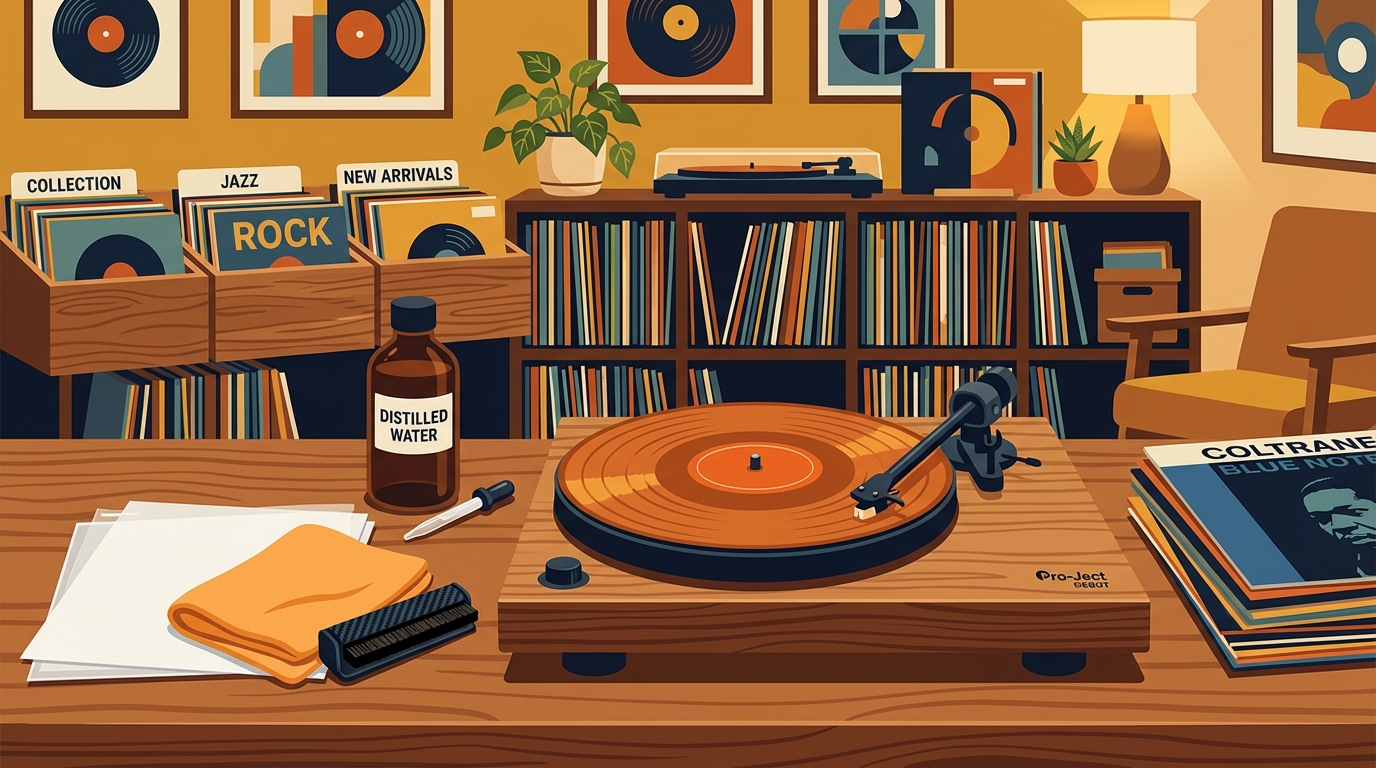
What you need
- A clean record-cleaning mat or a manual record-cleaning basin.
- A carbon-fiber brush for dry dusting before playback.
- A velvet or microfiber record-cleaning pad used only for records.
- A vinyl-safe cleaning solution, or a very mild archival-style solution made for grooved discs.
- Distilled or deionized water for rinsing.
- Clean microfiber towels, plus a dish rack or record rack for air drying.
- New anti-static inner sleeves for records that arrived in dirty paper sleeves.
One important format warning: this guide is for modern vinyl LPs and 45s. Do not wet-clean shellac 78s with the same routine. ARSC notes that cracked shellac discs should be dry-cleaned because moisture may spread cracks, and alcohol can damage shellac. If you collect 78s, treat them as their own format.
Step 1: Dry brush first
Put the record on the platter, start rotation, and hold a carbon-fiber brush lightly on the surface for a few revolutions. Do not press down. You are lifting loose dust, not sanding a floor. Angle the brush so the fibers follow the groove, then sweep the collected dust off the edge. Do this before every play, even after a wet clean, because sleeves and room dust never fully disappear.
Step 2: Wet-clean only when the record needs it
Wet cleaning is best for used records, visible fingerprints, sticky residue, or crackle that remains after dry brushing. Place the record on a clean mat or in a basin. Apply enough solution to wet the grooves, while keeping the label as dry as possible. Move the pad in the direction of the groove, never across it, using light pressure. If the record is truly dirty, give the solution a short dwell time according to the product instructions, then make another gentle pass.
Do not let cleaning fluid dry on the record. Drying solution can leave residue in the groove, which may sound like the problem you were trying to solve. A vacuum record-cleaning machine solves this neatly, but hand cleaning can still work if you rinse and dry carefully.
Step 3: Rinse with distilled water
Rinsing is the step many collectors skip. Use distilled or deionized water, not tap water. ARSC describes wet cleaning of grooved media with a mild solvent and deionized water, followed by drying. In a home setup, a distilled-water rinse helps remove loosened grime and any remaining cleaner.
Use a second clean pad for the rinse, not the same pad that carried the dirty fluid. Work with the groove again. If you are using a basin system, refresh the bath before it turns gray or dusty. A dirty bath becomes a soup your next record has to swim through.
Step 4: Dry completely before sleeving
Blot gently with a clean microfiber towel if needed, then air-dry the record upright in a clean rack. Wait until both sides are fully dry before playback or storage. Moisture trapped inside an inner sleeve can encourage paper residue, musty smells, and new contamination. If the old inner sleeve is dusty, yellowed, or shedding paper, replace it with a new anti-static sleeve. Putting a clean record back into a dirty sleeve is like showering and then putting on yesterday's socks, which is technically possible, but emotionally disappointing.
What not to do
- Do not use paper towels, bathroom towels, or shirts. They can shed fibers or abrade the surface.
- Do not scrub across the grooves. Follow the circular groove path.
- Do not soak the label.
- Do not use household cleaners such as glass cleaner.
- Do not play a wet record. The stylus is not a squeegee.
- Do not assume every crackle is dirt. Groove wear, non-fill, scratches, and pressing defects cannot be washed away.
How clean records help your collection
A clean record is quieter, easier on your stylus, and more pleasant to catalog because you can judge the pressing instead of the dust. If you use What's Spinning to track what you actually play, cleaning used arrivals before their first spin also makes your listening history more useful. You will know whether a copy is a keeper, a placeholder, or one to upgrade later.
The repeatable routine is simple: handle by the edges, dry brush before play, wet-clean dirty used records, rinse with distilled water, dry fully, and store in a clean sleeve. The less grime your stylus has to excavate, the more music your system gets to play.
FAQ
Can I clean vinyl records with tap water?
Use distilled or deionized water instead. Tap water can leave minerals behind in the groove, which is exactly the kind of residue you are trying to remove.
Is alcohol safe for vinyl records?
A small amount of isopropyl alcohol appears in some record-cleaning formulas, but avoid strong alcohol mixes and never use alcohol on shellac 78s. When in doubt, use a commercial vinyl record solution that lists its intended use clearly.
Do I need a record-cleaning machine?
No. A vacuum or ultrasonic machine can make batch cleaning easier, but careful hand cleaning with a record brush, proper fluid, distilled-water rinse, and full air drying can work well for home collections.
How often should I wet-clean my records?
Wet-clean a used record when you bring it home, or any record that has visible grime, fingerprint residue, or persistent crackle after dry brushing. For normal listening, a carbon-fiber brush before each play is usually enough.
Sources
A spreadsheet tracks what you own. What's Spinning identifies what's playing.
On-device vinyl ID logs your listening history automatically. 7-day free trial.
Looking for Shazam for vinyl?
What's Spinning identifies what's playing on your turntable on-device, logs history, and AirPlays now-playing to your TV.
Comparing vinyl ID apps?
Analog requires Discogs and is iPhone-first (iPad coming). What's Spinning works without Discogs on iPhone and iPad with AirPlay.
Try What's Spinning Free
Turn your iPad into a live now-playing display. Track every record you spin.
START FREE TRIALThen $4.99/mo or $39.99/yr · Cancel anytime