The Psychology of Vinyl Collecting: Why We Obsess
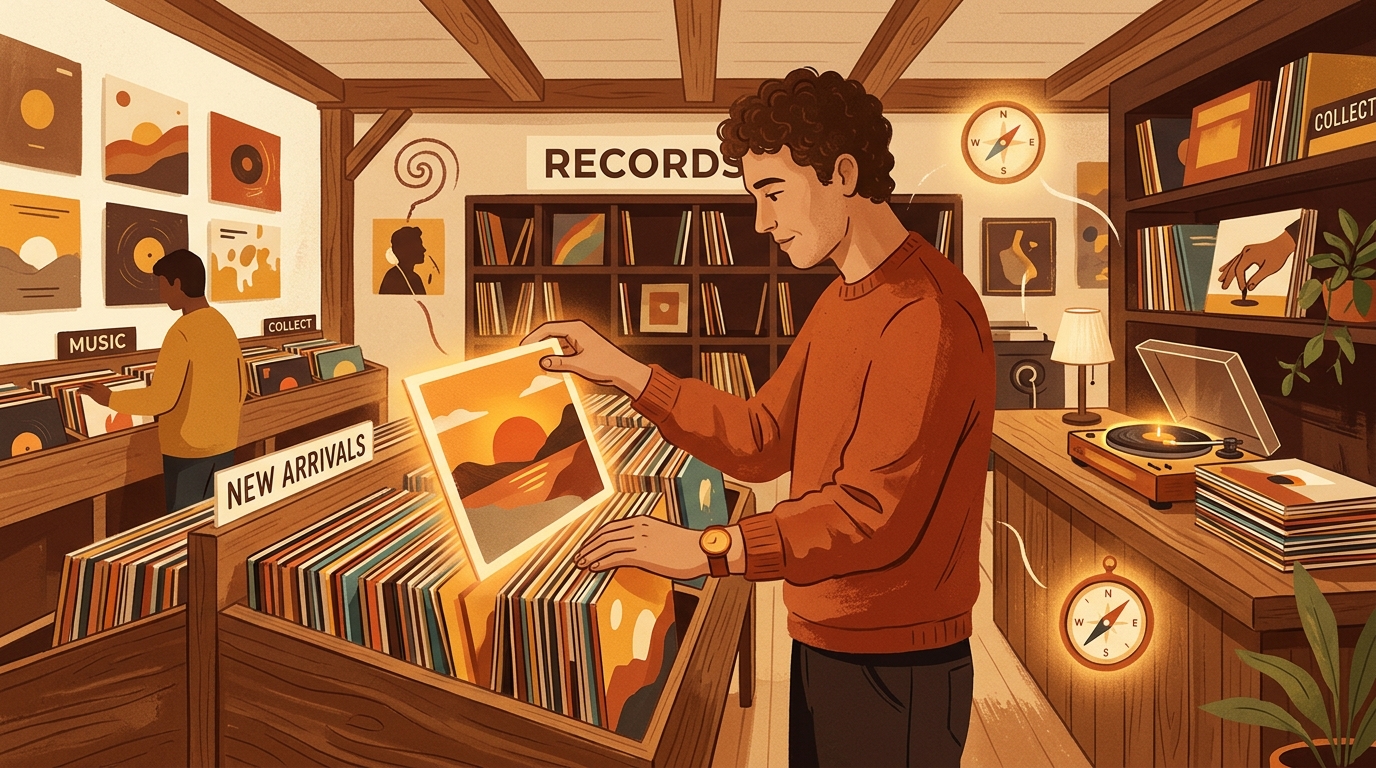
Vinyl collecting can look irrational from the outside. A streaming subscription provides nearly unlimited music, yet collectors spend weekends flipping through bins, compare matrix numbers, and feel a small electrical charge when a long-wanted pressing appears. The psychology of vinyl collecting obsession is not one single impulse. It is a mix of identity, memory, ritual, scarcity, discovery, and the oddly powerful pleasure of making music physically yours.
A record collection becomes part of the self
Consumer psychologist Russell Belk argued that possessions can function as an “extended self,” helping people express and maintain identity. A record shelf does this unusually well because every object carries several signals at once: taste, era, community, knowledge, and personal history. Owning a battered copy of London Calling bought at sixteen means something different from clicking “save” on the same album today.
This helps explain why collectors often organize records with such care. Alphabetical order is practical, but categories such as “records my dad played,” “local punk,” or “Sunday morning jazz” turn storage into autobiography. The collection says, “This is what moved me, and this is how I learned to listen.” Research on record collecting has likewise described collections as tools for identity construction and for negotiating the shift from material music to digital access.
The hunt delivers a variable reward
Record shopping is powered by uncertainty. Most trips produce a few maybes, some overpriced common titles, and nothing from the want list. Then a scarce pressing appears behind an unpromising stack. That unpredictable payoff resembles a variable reward schedule, the same basic pattern that makes surprise outcomes especially attention-grabbing.
The hunt also creates a satisfying learning loop. You remember label designs, catalog numbers, deadwax marks, regional shops, and which reissue series can be trusted. Expertise improves the odds of a good find, so collecting feels less like random shopping and more like a skill. What’s Spinning can help document the collection and current plays, but the emotional spark still comes from the collector recognizing something meaningful in the wild.
Scarcity turns preference into urgency
A limited pressing adds a deadline to desire. If only 500 copies exist, waiting feels risky, even when the album is available everywhere digitally. Numbered editions, colored variants, withdrawn covers, first pressings, and Record Store Day releases all convert ordinary preference into a decision under scarcity.
There is also an ownership effect. In classic experiments, people assigned higher values to objects they already possessed than to comparable objects they did not own. Collectors experience this when a record that seemed merely interesting becomes difficult to sell after entering the shelf. Once acquired, it joins the collection’s story, and giving it up can feel like losing more than the market price.
Vinyl makes listening into a ritual
Records impose friction, and that is part of their appeal. You choose an album, remove it from the jacket, clean the surface, cue the stylus, and turn the record over. These steps create a boundary around listening. Music becomes the activity rather than background material competing with messages and infinite scrolling.
Psychology research has found that people who engage with music through multiple behaviors, including attentive listening, performing, and sharing, tend to report greater well-being than people whose engagement is narrower. Vinyl does not automatically make anyone happier, but its physical routine encourages focused participation. A side lasting roughly twenty minutes also creates a natural unit of attention. You are more likely to hear sequencing, transitions, and the strange deep cut before the closer.
Nostalgia is memory with a physical handle
Nostalgia is not limited to people rebuying records from their youth. Younger collectors can feel nostalgia for an era they never experienced, sometimes called historical or vicarious nostalgia. Cover typography, liner notes, analog equipment, and the inherited ritual of playing a record offer contact with a music culture that feels slower and more tangible.
The format’s commercial revival shows that this desire is not marginal. The Recording Industry Association of America reported that U.S. vinyl revenue reached about $1.04 billion in 2025, with 46.8 million units shipped. Vinyl accounted for roughly 78 percent of U.S. physical music revenue. Streaming remains dominant, but millions of buyers still pay for an object that makes an album visible in the home.
Completion offers order, until it stops being fun
Collecting creates solvable goals. Find every studio album, complete a label run, obtain one original pressing from each favorite artist, or build a shelf around a scene. The rules reduce a vast musical universe to a manageable quest. Each acquisition closes a gap and produces a brief sense of completion.
The danger is that the goal can replace the music. Warning signs include hiding purchases, carrying credit-card debt, buying variants you do not enjoy, or feeling more anxiety than pleasure around the collection. A useful reset is to define limits: a monthly budget, a one-in-one-out shelf rule, or a requirement to play a record before buying another copy. Obsession is healthiest when it deepens listening rather than merely increasing inventory.
Why the obsession endures
Vinyl combines several rewards that digital libraries separate. It is music, an object, a memory cue, a knowledge system, a social signal, and a treasure hunt. The record ages with its owner. A crease, price sticker, inscription, or little burst of surface noise can become evidence of a life lived alongside the music.
That is why collectors rarely describe their shelves as mere storage. A collection is a map of attention. It records what you cared enough to seek, learn, preserve, and play again.
Frequently Asked Questions
Is vinyl collecting addictive?
It can become compulsive, especially when scarcity, shopping, and unpredictable finds drive repeated buying. Most collecting is a rewarding hobby. It becomes a problem when spending, secrecy, clutter, or anxiety causes harm or when acquiring records consistently matters more than hearing them.
Why does owning vinyl feel different from streaming?
Ownership creates permanence, physical cues, and a stronger sense of personal association. A record also requires deliberate handling, which can make the listening session more memorable than tapping a title in an unlimited catalog.
Why do collectors buy multiple copies of the same album?
Different copies may have distinct mastering, pressing plants, artwork, color variants, or sentimental value. Sometimes the motive is sonic comparison; sometimes it is completion. The useful question is whether each copy adds enjoyment or simply answers a scarcity-driven urge.
How can I keep vinyl collecting from getting out of control?
Set a fixed monthly budget, maintain a focused want list, wait 24 hours before expensive purchases, and track what you actually play. Selling duplicates and setting a shelf limit can also keep the collection intentional.
Sources
- Russell W. Belk, “Possessions and the Extended Self,” Journal of Consumer Research (1988)
- Daniel Kahneman, Jack L. Knetsch, and Richard H. Thaler, “Experimental Tests of the Endowment Effect and the Coase Theorem” (1990)
- David C. Giles, Stephen Pietrzykowski, and Kathryn E. Clark, “The Psychological Meaning of Personal Record Collections and the Impact of Changing Technological Forms” (2007)
- Vera W. Y. Chin and Neta Spiro, music engagement and well-being study, Scientific Reports (2021)
- RIAA, 2025 Year-End Music Industry Revenue Report
A spreadsheet tracks what you own. What's Spinning identifies what's playing.
On-device vinyl ID logs your listening history automatically. 7-day free trial.
Looking for Shazam for vinyl?
What's Spinning identifies what's playing on your turntable on-device, logs history, and AirPlays now-playing to your TV.
Comparing vinyl ID apps?
Analog requires Discogs and is iPhone-first (iPad coming). What's Spinning works without Discogs on iPhone and iPad with AirPlay.
Try What's Spinning Free
Turn your iPad into a live now-playing display. Track every record you spin.
START FREE TRIALThen $4.99/mo or $39.99/yr · Cancel anytime
Get it on your iPhone
Open on iPhone