The Best Vinyl Albums of the 1990s
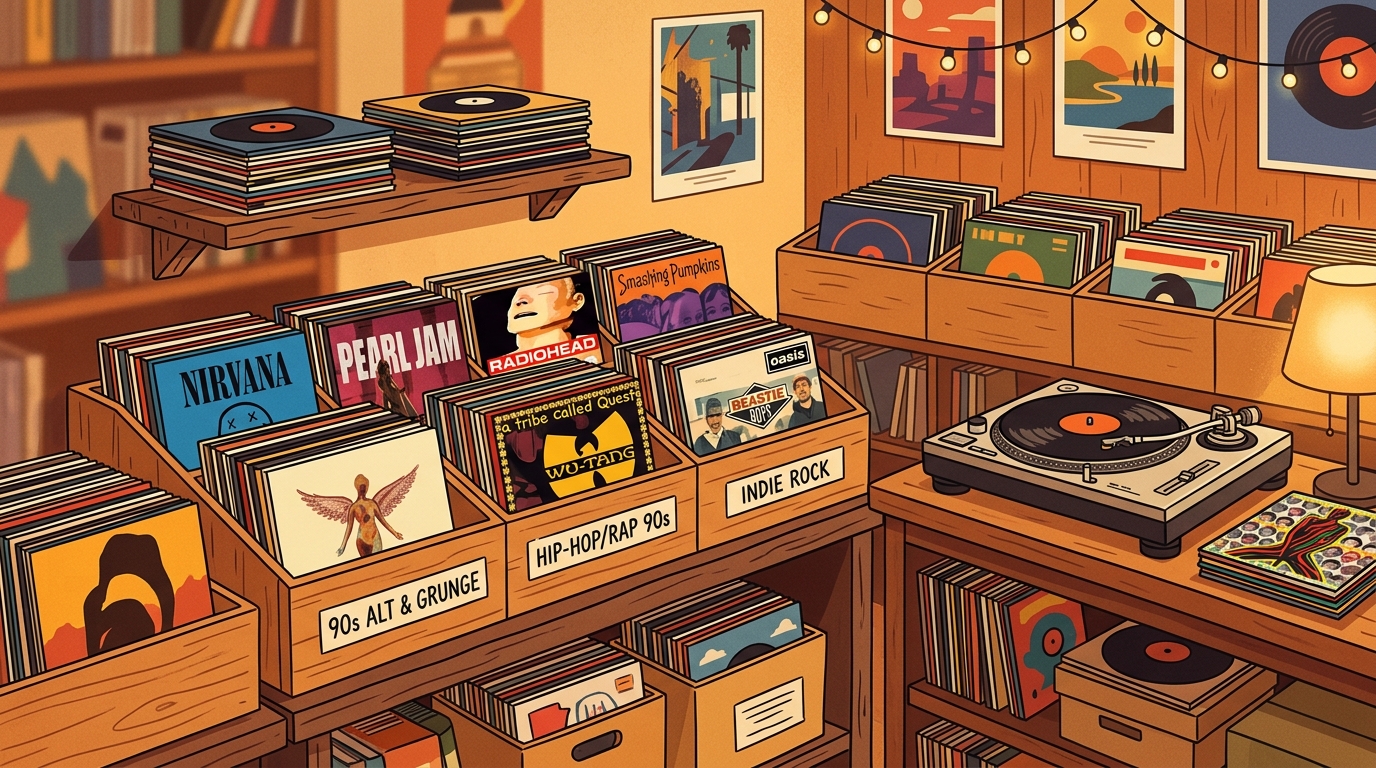
The best vinyl albums of the 1990s tell a slightly different story than the best 1990s albums on CD. This was the decade when compact discs became the default format, labels cut back on vinyl runs, and many LP editions quietly became scarce collector pieces. That makes the 1990s especially fun, and occasionally expensive, for record buyers today. Some of these albums were pressed in decent numbers in the UK or Europe but barely appeared on US vinyl. Others became reissue staples because the music never stopped finding new listeners. For collectors using What's Spinning to keep track of plays, condition notes, and repeat listens, the real question is not just what is canon. It is which records still feel alive across two sides of wax.
For context, the vinyl market of the 1990s was not the vinyl market we know now. RIAA's modern revenue reports show how dramatic the format's comeback has been, with vinyl driving a major share of physical music revenue in the 2020s, but the albums below came from the opposite environment: CD booklets, hidden tracks, long runtimes, and mastering decisions aimed at digital playback. That tension is why 1990s vinyl is so interesting. The decade produced landmark hip-hop, alternative rock, trip-hop, neo soul, electronic music, and art-pop albums, yet many of the original LPs were afterthoughts, imports, DJ tools, or limited runs. Here are 15 essential 1990s albums that reward listening, collecting, and careful pressing choices.
The best vinyl albums of the 1990s
Nevermind, Nirvana, 1991
Few records changed the commercial weather as abruptly as Nevermind. Released by DGC on September 24, 1991, and produced by Butch Vig, it pushed a band from the Seattle underground into the center of mainstream rock. The Wikipedia album history notes its sessions at Sound City in Van Nuys and Smart Studios in Madison, plus the later mastering work at The Mastering Lab in Hollywood. That matters on vinyl because the album sits between punk abrasion and radio polish; the guitars are huge, the drums are cleanly explosive, and the hooks were mixed to survive both car stereos and MTV.
Collectors should pay attention to pressing lineage. Original US vinyl is desirable partly because 1991 major-label vinyl was no longer the default purchase. European pressings were often easier to find, and later reissues vary in cut, weight, and packaging. The album's side structure also helps it on LP. Side one is a nearly perfect escalation from "Smells Like Teen Spirit" through "Polly," while side two lets the stranger, darker songs breathe. It is a record whose familiarity can dull the shock, but a good vinyl copy restores the physical punch of Dave Grohl's drums and Krist Novoselic's bass.
OK Computer, Radiohead, 1997
OK Computer is often treated as the moment Radiohead outgrew guitar rock, but the vinyl appeal is more tactile than that summary suggests. The album was released in May 1997, with Nigel Godrich producing, after sessions that included the band's Oxfordshire rehearsal space and St Catherine's Court near Bath. Its anxious themes of consumerism, travel, technology, and social exhaustion are well documented, yet the production is the collector's hook. Acoustic guitars, Mellotron, distorted electric textures, close-miked vocals, and sudden bursts of noise are arranged with enough space to make an LP feel architectural.
The 1990s CD era encouraged long albums, and OK Computer is long enough that pressing quality matters. Many collectors favor editions that preserve dynamics rather than exaggerating the already dense climaxes. On wax, "Exit Music (For a Film)" and "Let Down" gain scale because the quieter passages are not simply waiting rooms for the loud parts. The artwork also feels unusually suited to the format, a collage of transport diagrams, white space, and corporate unease that makes more sense at jacket size than in a jewel case. For anyone building a 1990s shelf, it is both a period document and a record that predicted the next one.
The Miseducation of Lauryn Hill, Lauryn Hill, 1998
Lauryn Hill's solo debut arrived in August 1998 and immediately felt bigger than a normal crossover success. Written and produced largely by Hill, The Miseducation of Lauryn Hill folds hip-hop, soul, reggae, gospel, and classroom interludes into a concept about love, self-knowledge, faith, motherhood, and public pressure. It won the Grammy Award for Album of the Year, a landmark moment for hip-hop and neo soul, and it remains one of the decade's clearest examples of commercial reach meeting personal authorship.
On vinyl, the challenge is runtime. The album is generous, closer to a full evening than a compact statement, so a clean multi-disc edition is preferable to any cramped presentation. The warmth of the bass and the grain in Hill's voice are the reasons to own it physically. "Ex-Factor" has a slow-burn spaciousness that rewards a quiet pressing, while "Doo Wop (That Thing)" proves how naturally the record balances radio immediacy with live-band feel. Buyers should check packaging and side splits carefully because this is an album built from flow, skits, reprises, and emotional sequencing. A strong vinyl edition lets those transitions feel intentional rather than simply archival.
Loveless, My Bloody Valentine, 1991
Instead of announcing itself with a conventional rock mix, Loveless seems to arrive as a weather system. My Bloody Valentine's second album was released in 1991 by Creation in the UK and Sire in the US, after a famously long recording process led by Kevin Shields. Wikipedia summarizes the production history as stretching across many studios, with Shields using glide guitar, unusual tunings, sampling, and painstaking overdubs. The rumored cost and studio churn have become part of the myth, but the real story is in the sound: guitars behaving like tape, breath, and machinery at once.
Vinyl can be magical for this album, but it is also unforgiving. Surface noise competes directly with the soft-focus textures, so condition is not a small detail. The best copies make "Only Shallow" feel enormous without turning the treble into sandpaper, and they let "Sometimes" float instead of smear. Collectors also debate analog versus digital sources on different reissues, which is understandable for a record so bound up with texture. Still, do not reduce Loveless to an audiophile puzzle. The songs are sturdy beneath the blur, and the LP format gives the album's two halves a dream logic that streaming queues rarely preserve.
Enter the Wu-Tang (36 Chambers), Wu-Tang Clan, 1993
The grimy force of Enter the Wu-Tang (36 Chambers) comes from limitations turned into identity. Released in November 1993 by Loud and RCA, the debut was built around RZA's production, martial-arts dialogue, basement-level grit, and a nine-member crew whose voices sounded like competing pirate radio transmissions. The album's title references Enter the Dragon and The 36th Chamber of Shaolin, but its deeper importance is regional. It helped pull New York hip-hop back into national focus at a moment when West Coast production dominated mainstream rap conversation.
For vinyl collectors, this is a record where texture beats polish. The drums are dusty, the samples are jagged, and the vocal takes feel close enough to scuff the speaker cones. A sterile pressing misses the point, but a noisy, worn copy can also swallow the details that make the group chemistry so thrilling. Listen for how "C.R.E.A.M." opens space around the piano loop, or how "Protect Ya Neck" turns overlapping personalities into a full-contact posse cut. Original pressings and later reissues can differ noticeably in level and low-end weight. The best version is one that keeps the menace without flattening the voices into one block.
In Utero, Nirvana, 1993
After the impossible success of Nevermind, Nirvana made the most interesting possible follow-up: a record that sounds like it distrusts its own audience. In Utero was recorded in February 1993 at Pachyderm Studio with Steve Albini, whose engineering emphasized room sound, abrasive guitars, and physical drum impact. The public story included rumors that DGC worried about the album's commercial potential, plus later remix work on selected tracks. That history is inseparable from the way collectors hear it now because the album has always been framed as a fight over how raw a major-label rock record could be.
The LP format highlights the tension between beauty and abrasion. "Serve the Servants" starts almost casually, then the record keeps opening trap doors: "Scentless Apprentice" is punishing, "Dumb" is disarmingly plainspoken, and "All Apologies" feels both graceful and cornered. Albini's sound can be thrilling on vinyl when the cut preserves the drums and does not sand down the high end. Buyers should compare editions with care because this is one of those 1990s records where source, mix, and mastering notes matter to fans. It is not merely a companion to Nevermind; it is the album that makes the earlier breakthrough feel complicated.
Dummy, Portishead, 1994
Dummy is the rare debut that seemed to invent a room around itself. Released by Go! Beat in August 1994, Portishead's first album won the 1995 Mercury Music Prize and helped popularize trip-hop far beyond Bristol. Its palette is instantly recognizable: Beth Gibbons' bruised voice, Geoff Barrow's production, spy-film strings, turntable crackle, hip-hop pacing, and arrangements that treat silence as part of the rhythm. Wikipedia notes that the album had sold 3.6 million copies worldwide by 2008, proof that its shadow reached well beyond specialist listeners.
Because the music already plays with surface noise and sampled age, vinyl adds a sly extra layer. The danger is that a beat-up copy can make intentional crackle indistinguishable from groove wear, so grading matters. "Sour Times" and "Roads" need black backgrounds to fully bloom, while "Strangers" depends on bass that is deep but controlled. For collectors, Dummy is also a cover-art album: the stark image from the short film To Kill a Dead Man looks properly cinematic at LP scale. It is one of the decade's essential late-night records, not because it is mellow, but because every sound feels like it has been lit from one bare bulb.
Illmatic, Nas, 1994
The power of Illmatic is partly that it refuses to overstay. Released in April 1994 through Columbia, Nas's debut is concise, literary, and unusually unified despite using several elite producers, including DJ Premier, Large Professor, Pete Rock, Q-Tip, and L.E.S. The album's Queensbridge narratives, internal rhymes, and cinematic detail have been analyzed for decades, but the vinyl argument is simple: at a time when hip-hop albums often stretched across skits and filler, Illmatic moves like a perfect short film.
A good LP copy makes the production credits feel like chapters in one city map. Pete Rock's horn loop on "The World Is Yours" has a reflective glow; DJ Premier's work on "N.Y. State of Mind" is stark and claustrophobic; Q-Tip's "One Love" turns letter-writing into a suspended groove. Collectors should know that 1990s hip-hop vinyl sometimes existed for DJs as much as home listeners, so condition can vary wildly. Clean copies are worth the patience. The album cover, with Nas's childhood portrait over the Queensbridge Houses, is one of the decade's defining sleeves, and the record behind it still sounds startlingly young, precise, and unsentimental.
Automatic for the People, R.E.M., 1992
R.E.M. entered the 1990s as alternative rock elders and somehow made one of the decade's most durable mainstream albums by slowing down. Automatic for the People was released in October 1992 by Warner Bros., while the band was still riding the success of Out of Time. Several tracks feature string arrangements by John Paul Jones, a detail that could have turned showy in lesser hands. Instead, the strings deepen the album's mood of mortality, memory, and uneasy comfort.
On vinyl, the record's restraint becomes its selling point. "Drive" has a dry, almost skeletal pulse; "Try Not to Breathe" turns small melodic movements into emotional pressure; "Nightswimming" benefits from the physical pause before the album's final stretch. Since the production is not trying to overwhelm you, pressing noise and inner-groove distortion are more noticeable than they would be on a louder rock record. Buyers should seek copies that keep Michael Stipe's voice centered and the acoustic instruments natural. This is also a reminder that not every essential 1990s LP is rare because of underground status. Sometimes the collectible appeal comes from a huge band making a quiet record at exactly the right moment.
Siamese Dream, The Smashing Pumpkins, 1993
The guitar sound on Siamese Dream is not just big; it is obsessively layered. Released by Virgin in 1993 and produced by Butch Vig with Billy Corgan, the album arrived from sessions marked by pressure, band tension, and Corgan's perfectionist control. The result debuted in the Billboard 200 top ten and later reached multi-platinum status in the United States, but its scale still feels homemade in a strange way, like a bedroom anxiety attack rebuilt with arena-sized amplifiers.
Vinyl exposes both the beauty and the density. "Cherub Rock" needs enough headroom for the opening shimmer to become a wall; "Today" relies on the contrast between candy-colored melody and depressive lyric; "Mayonaise" is where the album's guitar layering becomes emotional architecture rather than excess. Some versions can sound congested if the mastering pushes the mids too hard, so collectors should read pressing notes and reviews before paying premium prices. The cover art, with its dreamlike child portrait, has become inseparable from the record's mix of innocence and distortion. In a decade full of alternative breakthroughs, Siamese Dream remains one of the clearest examples of studio obsession turning into mass appeal.
The Low End Theory, A Tribe Called Quest, 1991
Bass is the headline, but space is the secret. A Tribe Called Quest released The Low End Theory in September 1991, fusing jazz samples, conversational rhymes, and a low-frequency sensibility that made the album feel both relaxed and exact. Its influence on alternative hip-hop and jazz-rap is obvious now, yet the record still avoids museum-piece stiffness because Q-Tip and Phife Dawg sound so alive inside the pocket.
This is one of the strongest arguments for hip-hop on vinyl when the pressing is right. The kick drums and upright bass textures need body, not boom, and the vocals should sit cleanly above the groove. "Excursions" opens with a direct statement of lineage, connecting hip-hop bass to jazz memory, while "Check the Rhime" and "Jazz (We've Got)" prove that sophistication does not require clutter. Original and early pressings can command collector money, but later reissues often serve listeners well if they are cut with care. Visually, the Bonita Applebum-style painted figure from Tribe's artwork universe is instantly recognizable at jacket size. Sonically, the record remains a lesson in how little you need when every element is placed correctly.
Blue Lines, Massive Attack, 1991
Blue Lines does not rush to prove its importance. Released in April 1991, Massive Attack's debut helped define the Bristol sound before the term trip-hop became a marketing shortcut. The record brings together dub pressure, hip-hop pacing, soul vocals, and soundsystem culture, with Shara Nelson's performance on "Unfinished Sympathy" giving the album one of the decade's most enduring emotional peaks. It is less noir than Dummy, more communal, more open-air, and more connected to club and street movement.
For collectors, the album's vinyl value sits in the way the low end behaves. A thin pressing weakens the entire premise, while a strong one lets the basslines carry weight without muddying the vocals. "Safe from Harm" and "Five Man Army" show how carefully the record balances collective identity, guest voices, and negative space. The original sleeve's flame logo is also a beautiful example of early 1990s minimalism, bold enough for a wall, clean enough to look contemporary decades later. If your 1990s collection leans too heavily on guitar bands, Blue Lines is the corrective. It captures a different future arriving at the same time.
Screamadelica, Primal Scream, 1991
The smiley-sun cover tells part of the story before the needle moves. Screamadelica, released in 1991, is the point where Primal Scream's rock identity collided with acid house, dub, gospel, and Andrew Weatherall's club-wise production imagination. It won the first Mercury Music Prize in 1992, which helped formalize its status as more than a scene record. What keeps it interesting on vinyl is that it behaves like both an album and a comedown mix, moving from euphoria to drift without asking permission.
The LP format suits its changes in temperature. "Movin' On Up" opens with gospel-rock lift, "Loaded" stretches into sample-based dance-rock mythology, and "Higher Than the Sun" dissolves into something slower and stranger. Pressing choice matters because the record's bass and high-frequency effects need room, especially on systems that can handle dance music without smearing it. Collectors also love the sleeve for obvious reasons; Paul Cannell's artwork is one of the decade's great record-store images, bright, naive, and instantly identifiable from across a room. Among 1990s albums that captured British club culture leaking into rock, Screamadelica is still the one that feels most generous.
Dookie, Green Day, 1994
Dookie is faster, tighter, and funnier than its reputation as a pop-punk breakthrough sometimes allows. Released by Reprise in 1994, Green Day's third album took the East Bay punk vocabulary into suburban bedrooms, MTV rotation, and mall record stores without losing its bratty efficiency. Rob Cavallo's production gave the band enough gloss for radio while keeping the guitars clipped and percussive. The songs are short, but the album's cumulative design is ruthless: anxiety, boredom, lust, panic, and jokes fired in quick succession.
On vinyl, the main pleasure is momentum. The record does not need audiophile grandeur; it needs a pressing that keeps Tre Cool's drums snapping and Mike Dirnt's bass lines audible beneath Billie Joe Armstrong's guitar. "Longview" is the obvious bass showcase, but "Basket Case" and "When I Come Around" reveal how carefully the choruses are arranged. The cover art by Richie Bucher rewards LP ownership because its chaotic cartoon details are easy to miss at CD size. For collectors who sometimes overcorrect toward prestige, Dookie is a useful reminder that a perfect 1990s vinyl album can be direct, cheap-thrill melodic, and built for repeat play.
Grace, Jeff Buckley, 1994
Jeff Buckley's Grace is a collector favorite because it turns vocal presence into atmosphere. Released in 1994 by Columbia, the album did not become a blockbuster on arrival, but its reputation grew steadily after Buckley's death in 1997. The music draws from folk, rock, soul, Qawwali influence, and art-song drama without settling into singer-songwriter politeness. That range can be difficult to cut well because the album moves from whisper-level intimacy to high, ringing climaxes.
A strong vinyl copy should make "Mojo Pin" feel suspended, not fragile, and should let "Grace" surge without hardening Buckley's upper register. "Hallelujah" is now so culturally overused that it can be hard to hear freshly, but the LP context helps. It becomes one performance among many rather than the entire monument. Collectors should watch for editions spread across enough sides to protect the dynamics. This is not background music for expensive speakers; it is a record about risk, breath, and control. The jacket portrait is simple, almost modest, which works because the drama is all in the grooves. Among 1990s albums that became larger after their moment, Grace may be the most haunted.
What to buy first
If you are starting a 1990s vinyl shelf from scratch, begin with records that justify the format rather than titles that merely complete a canon. First, buy Dummy or Blue Lines if your system handles bass well; both make the room feel different. Second, choose Nevermind or Siamese Dream if you want the decade's alternative-rock scale in full jacket-sized form. Third, add Illmatic or The Low End Theory to keep hip-hop central rather than treating it as a side category. Fourth, save patience and budget for Loveless or Grace, because condition and mastering can change the experience dramatically. Finally, do not ignore reissues. For many 1990s albums, a thoughtful modern reissue is a better listening copy than an overpriced original with groove wear.
FAQ
Why are some 1990s vinyl albums so expensive?
Many 1990s albums were released when CDs dominated the market, so original vinyl runs were often smaller than comparable 1970s or 1980s pressings. Demand later grew as vinyl collecting returned, which pushed prices up for clean originals, imports, promo copies, and albums that were never widely pressed on LP in the United States.
Are original 1990s pressings always better than reissues?
No. Originals can be collectible and historically interesting, but they are not automatically the best listening copies. Some were cut from digital masters, some were pressed during a low-priority era for vinyl, and many surviving copies have DJ or party wear. A well-mastered reissue can be quieter, cheaper, and more satisfying.
Which genres from the 1990s are most rewarding on vinyl?
Trip-hop, alternative rock, hip-hop, neo soul, and electronic albums all reward vinyl listening for different reasons. Trip-hop and hip-hop benefit from strong low-end reproduction, alternative rock gains physical impact, and neo soul often benefits from the warmth and scale of a good LP cut.
How should I track which pressing I own?
Use the catalog number, barcode, matrix/runout notes, label variation, country, and year. For 1990s albums, those details matter because two copies with the same cover can come from very different mastering and pressing histories. Keeping notes after each play also helps you remember whether a copy is truly satisfying or just collectible.
Sources and further reading
A spreadsheet tracks what you own. What's Spinning identifies what's playing.
On-device vinyl ID logs your listening history automatically. 7-day free trial.
Looking for Shazam for vinyl?
What's Spinning identifies what's playing on your turntable on-device, logs history, and AirPlays now-playing to your TV.
Comparing vinyl ID apps?
Analog requires Discogs and is iPhone-first (iPad coming). What's Spinning works without Discogs on iPhone and iPad with AirPlay.
Try What's Spinning Free
Turn your iPad into a live now-playing display. Track every record you spin.
START FREE TRIALThen $4.99/mo or $39.99/yr · Cancel anytime